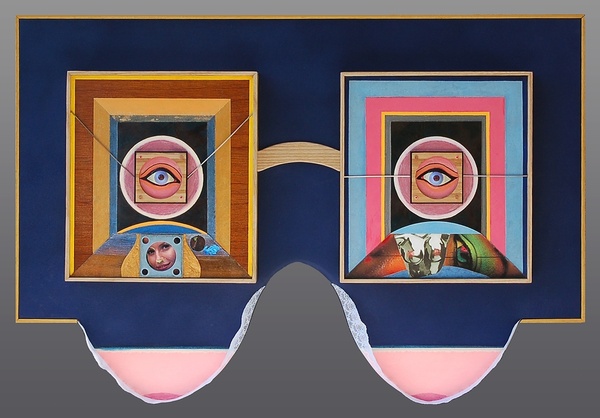
This is one of three pieces of work conceived in 1997 based on the central image of a very well appointed young lady. I first came across the model in question during my first year away at secondary school. There she was, probably no more than a couple of inches tall, posturing towards the back of a pocket size magazine, belonging to one of my schoolboy pals, printed solely in black and white. Well, when one is a thirteen year old boy with fast developing hormones, images like this had quite an effect, certainly that was the case in 1960. So much so, the magazine found its way into my hands and the appealing photograph cut out.
In those days, stationery items were much less developed than they are nowadays; in order to protect this discovered ‘icon’, I attached this find onto a thin piece of card, using slender bands of sticky-back plastic. The resulting treasure was then keep for safety in a wallet. Over the ensuing years the wallet was lost to the sands of time and completely forgotten, even too Mademoiselle, in her french camiknickers and arresting pose. However, when moving house about a third of a century later, I found the wallet with this once precious forgotten item in it.
The passing years had had their effect, not so much on my hormones but on this little paper image. The glue of the sticky-back plastic had permeated the paper printed on both sides and drawn the reverse side image through to be partly visible from the front. The same process was happening here, all be it accidentally, as was being developed by me in various other pieces of artwork at this time, viz. the relationship and quality of an image to the depth of surface and how it consequently read. In striving to be an artist, any form of inspiration is welcome and this chance rediscovery was no exception.
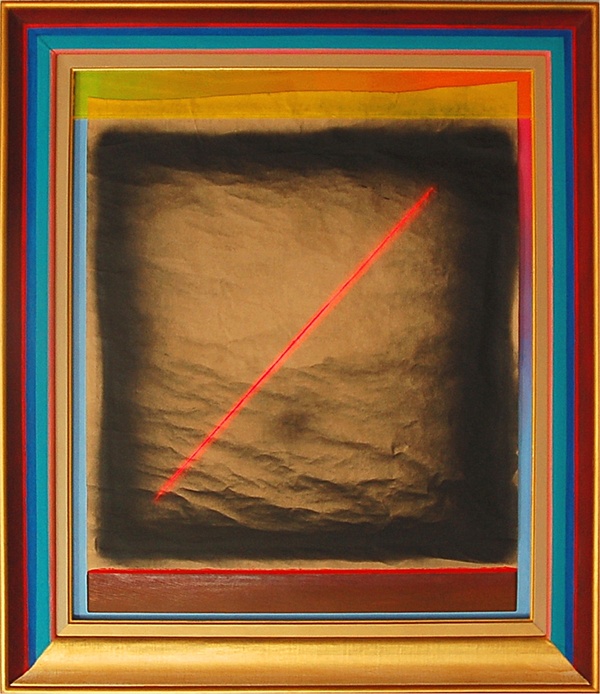
The other main element of this work is, of course, the image of Michelangelo’s David’s genitalia. When on a PGCE course at Bristol University, I was preparing an illustrated lecture on light and the colour spectrum, something I had studied extensively whilst producing my ‘Light Organ’ of 1968 /70. The coloured bands either side of the central image of the girl are, in fact, enlargements of a snippet of 8mm. film that was made as part of this illustrated lecture.
White light is broken into a band of spectral colours when passed through a prism, whilst the reverse action produces white light. By way of a little amusement, I chose to insert one second’s worth of a monochrome image of David’s groin into the film. These I interspersed with the same number of frames of pure coloured light to see how it blended to make what we perceive as white light. Students whose power of concentration was being challenged by the warmth of the lecture room and the quasi academic nature of the film topic were, for a brief moment, stirred into some form of awareness when, from the whiteness of the screen, David’s ‘wedding tackle’ appeared before their eyes. A chimera to appeal to a student generation. These eighteen frames were cut out of the film before another showing to a more adult audience and filed away only to be rediscovered in the same way as the picture of the girl.
As a result of these two souvenirs of the past coming to light at about the same time, it was pretty clear sailing before a trilogy of works came into being, ‘Pin up in my Pocket’, ‘Forbidden Sailor’* and this one, ‘Hello Fruit’. The close up of David’s private parts and the generosity of the girl have given me the chance to wallow in happy memories and produce three reasonable pieces of work.
* ‘Forbidden Sailor’ is now in a private collection and therefore not for sale on Artlimes.